Author Archives: Jim
Hard to plan the day

E.B. White, in a 1969 interview with Israel Shenker:
If the world were merely seductive, that would be easy. If it were merely challenging, that would be no problem.
But every morning I awake torn between the desire to save the world and an inclination to savor it.
This makes it hard to plan the day!
Photo by Jeff Clay, Clayhaus Photography
Welcome to the Golden Tablet Age of long-form journalism
Just when it seemed that journalism had been reduced to pithy two-paragraph blog posts and three-minute TV news or website video snippets, with 15-minute “in depth” reports on 60 Minutes being the height of investigative insight, a shining light has appeared through the clouds!
Fueled largely by the emergence of the Kindle as a place to read during down-time without staring into a glowing screen, and further encouraged by the more recreational media browsing that’s become popular on the iPad, “long-form journalism” is making a dramatic comeback in this age of bite-sized news. Thanks to several excellent editorial aggregators, lovers of the well-crafted essay, compelling profile, and in-depth on-the-ground reporting from around the globe now have easy access to the best work of the world’s best journalistic writers. Drawing from current print and online publications, as well as the archives of such stalwarts of the form as The Atlantic, The New Yorker, The London Review, Vanity Fair, Foreign Affairs, and many more, these sites offer a treasure-trove of writing that’s well worth settling down with for a half hour or hour.
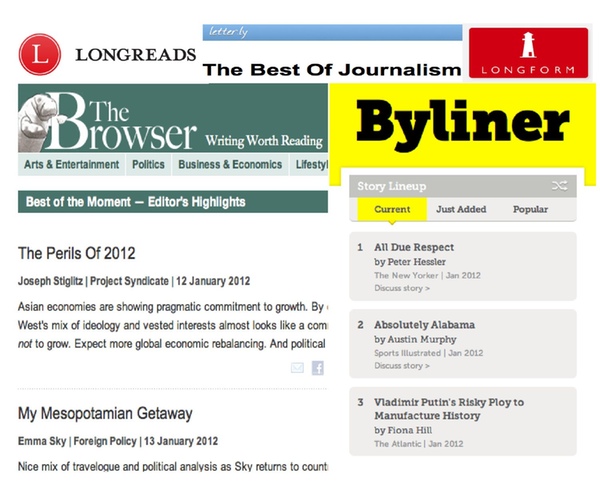
From these sites (links below), you can check out the opening sections of their latest recommended items and load the full pieces in your browser, then send them to your Kindle (with readily-available plug-ins), add them to your Read It Later or Instapaper reading list, perhaps to be accessed from your iPad or laptop some evening or weekend, or, of course, read right on your computer.
Just as a taste, today’s top selections include a Foreign Policy piece by a recent visitor to Iraq, a new Atlantic piece on Vladimir Putin’s risky game of bending history in Russia, a Grantland look on concussions in high school football, a piece from Businessweek on the inventor of a revolutionary new sneaker that never made it to market, and an Adbusters look at “peak nature.” Oh, and an old 1952 tour of trailer parks and a new Sports Illustrated profile of Michael Jordan’s high school coach. Longform’s Best of 2011 included an incredible 3-part cautionary tale about Derek Boogaard, an NHL “enforcer,” a heart-wrenching story about Vaughn, Georgia, one of the towns wiped from the map by last year’s tornado swarms, one on a blind man who learned to navigate his world by echolocation, and a visit to a crazy Russian movie set, home to thousands. While no one will be interested in all of this, a weekly perusal of these sites is sure to reward every reader with a few gems.
I encourage you to check a few of these editorial sites out, and see which ones strike your fancy over time. I get something from them all. Byliner is the most reliably
Neil Young’s ode to veterans
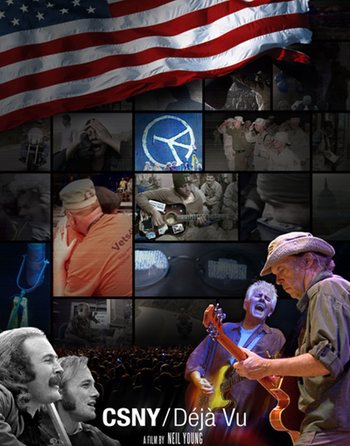
Ah, another real surprise from my Netflix streaming queue! Tonight, I clicked on CSNY Deja Vu, Neil Young’s movie of the 2006 tour that came together in the wake of Neil’s album, Living With War, expecting to find a concert film with a few topical touches around the edges. Woah, Nellie, was I off base! Instead, the four old hippies play supporting actor roles for a slew of Iraq and Vietnam war veterans and family members in a pean to the hearts and souls of those who’ve followed their leaders into battles that, in the end, just didn’t make sense. Neil even got Mike Cerra, a CNN reporter who spent three tours with a unit in Iraq, to “embed” with the tour and provide a documentary-within-the-movie about how people reacted to the tour, in the midst of that heated “you’re either with us or with the terrorists” period in America.
I suppose this shouldn’t have been such a shock. While Neil’s album got the most attention for two rousing anthems, Let’s Impeach the President, and Looking For a Leader (presaging the 2008 primaries: “…maybe it’s a woman, or a black man after all…”), at its heart were five moving songs honoring the sacrifices and eternal burdens of our men and women in uniform. One was a sung from the point of view of a soldier who didn’t return, wishing he could be with his family (clip on YouTube); the title track sang for the internal and external wounds, “I’m living with war….every day…in my heart…..in my mind; I take a holy vow, to never kill again, to never kill again…” (clip on YouTube; also not available for embed)
With the movie, Neil took this theme and moved it front and center, creating a moving portrait of the costs, and the folly, of war, and celebrating anti-war veterans from the 60’s and the 90’s. The songs become interludes, a thematic backdrop to the human story; we generally hear just a verse or two of most of the tunes, both new and old. At the movie’s climax, “Find the Cost of Freedom” is transformed from a hymn of resistance into a requiem for every soldier killed in Iraq up til then, vets singing along, moms in tears….and as on the album, the encore during the fade-out is David, Stephen, Graham, and Neil bringing their celestial harmonies to bear on “America the Beautiful.” These old songsters remind us, and the younger generation, that the hippie vision was always about the deep, true heart of the dream of what American can, and should, be.
Wowser. Nicely done, Bernard Shakey.
Howl, the movie
Wow, wow, wow.
I finally got around to watching Howl, the movie made a couple years ago about Ginsberg’s poem, the obscenity trial (Ferlinghetti, the publisher, was the defendant, not Allen), and…and…..well, that’s where I had no idea. This is an incredible portrayal of the artistic quest, the reaching to grasp that which is untouchable and express the ineffable, as well as the inner journey to know and to embrace ones’ self and soul.
The movie invites us deeply into the heart of the young Allen Ginsburg, via segments featuring his famous first reading of Howl, and a series of reflections posed as an interview in his apartment while the trial was taking place, in which Ginsburg shares bits of his life and glimpses of the passion and the craft behind his evocations of the holy mystery.
Howl is streamable on Netflix (where the “This Film Is” two-adjective description nails it: “Cerebral, raunchy”). Go for it.
Ten times a day

Ten times a day something happens to me like this – some strengthening throb of amazement – some good sweet empathetic ping and swell.
This is the first, the wildest and the wisest thing I know: that the soul exists and is built entirely out of attentiveness.
Mary Oliver
(can’t find the source, though it appears to be prose, in that every time it appears online it has no line breaks.)
Occupy the Future
As we turn the page from 2011, the year when the world rose up and said “enough!” and now embark on the journey of 2012, a year arriving with mythic baggage galore, I find myself heartened by big-picture reflections from several writers who often shed fresh light on our society’s struggles and dreams. Over the past couple of weeks, I’ve seen pieces by Alex Steffen, Rebecca Solnit, Starhawk, and Michael Meade that are typically incisive and heartening; each has his or her own deeply resonant perspective on life, society, and engagement, and I recommend them all!
Rebecca Solnit sets the tone with her year-end missive, Compassion is Our New Currency:
Occupy has some of the emotional resonance of a spiritual, as well as a political, movement. Like those other upheavals it’s aligned with in Spain, Greece, Iceland (where they’re actually jailing bankers), Britain, Egypt, Syria, Tunisia, Libya, Chile, and most recently Russia, it wants to ask basic questions: What matters? Who matters? Who decides? On what principles?
Stop for a moment and consider just how unforeseen and unforeseeable all of this was when, on December 17, 2010, Mohamed Bouazizi, a Tunisian vegetable vendor in Sidi Bouzid, an out-of-the-way, impoverished city, immolated himself. He was protesting the dead-end life that the 1% economy run by Tunisia’s autocratic ruler Zine Ben Ali and his corrupt family allotted him, and the police brutality that went with it, two things that have remained front and center ever since. Above all, as his mother has since testified, he was for human dignity, for a world, that is, where the primary system of value is not money.
Storyteller of the soul Michael Meade hits the nail on one of its many heads with his recent piece, Occupy vs. Nihilism: All or Nothing at All:
The Occupy movement may be an instinctive response, not just to the greatest disparity of wealth and power in the history of America, but also to the emptying out of institutions and loss of meaning at all levels of life. An underlying instinct to inhabit life more fully may be arising and taking root in different places for different reasons. The message of Occupy may be “all over the place” because the underlying message is about “place,” about reclaiming and more fully inhabiting public places, about being more present to the critical issues in each place, and about taking one’s own place in life more fully.
…
When mini-Occupy sites appear at individual houses threatened with foreclosure and neighbors set aside typical disagreements in order to protect each other’s homes, the roots of community are trying to resurface. Genuine grass roots movements can cross typical “party lines” and dissolve class distinctions as the deep-rooted connections between people and the underlying dreams of the country rise up from below. The difference and distance between those who inhabit the land and those who rule the nation become revealed. For, it is not simply that government has gotten too big, but that it has become so empty of meaning and devoid of the values that sustain common humanity.
Alex Steffen, of WorldChanging fame, recently reposted a piece he wrote in early 2010, entitled Putting the Future Back in the Room. He sets the tone this way:
The future that my parents’ generation warned us about forty years ago looks an awful lot like our present. The ice caps are melting, deserts are spreading, the planet is thick with people, most of the world’s primeval forests are gone, the seas are in crisis, and pollution, famine and natural disasters kill millions of people a year. Compared to the world we might have had, had the progress of the early 1970s continued steadily through the following four decades, we live on a half-ruined planet.
That half-ruined planet, though, is our home. People old enough to remember the first Earth Day can well grieve for that other, healthier Earth we might have had if only older generations had made different choices. Kids born today won’t have that luxury. This world is the only one they’ll ever know: they’ll have to make the best of it; life goes on.1970 is the same distance in time away from us now as 2050: that’s how close the future is…In an amount of time about equal to that from the first Earth Day, we have to remake the world.
Starhawk’s most recent missive addresses one of the key human challenges facing those currently engaged in this attempt to remake the world, which involves finding ways to compassionately respond to and provide for the needs of some of our most outcast citizens, the homeless and neglected people who tend to become a major presence at most urban Occupy sites. The inclusiveness and compassion at the heart of the Occupy movement creates social dynamics we’re not used to: the marginalized people are welcomed rather than ostracized, and in most cities have become a significant presence in the social reality of the camps and the General Assembly meetings (rather than being limited to their normal role as a tiny sliver of our daily lives, easily – and unfairly – discounted as merely drunks or freeloaders or lacking in ambition). In the occupy camps, they are seen in their full complexity, as human beings with their own particular backgrounds and perspectives and wounds. It’s manifested in the dynamics between the drum circles and those working to accommodate neighbors living near encampments; it’s also common to hear of General Assemblies being disrupted and pulled far off-topic by verbal outbursts from folks who react badly to any structure, planning, or authority. The challenging dynamics this creates has been the focus of some media features, and crops up in the reflections of most facilitators:
Even more than troubles with the cops and city authorities, the biggest challenges the Occupy movement faces seem to be internal. How do we make decisions together? How do we resolve our own conflicts within our groups? Once we’ve said “We are the 99%”, how do we set standards of behavior and say what is okay and what is not? Once we’ve renounced force and coercion, how do we enforce those standards when we do set them?
None of these are easy questions to answer, (and) the Occupy movement poses them in a form more stark than I’ve ever encountered before, in four decades of horizontal organizing. Sitting down in the public square to Occupy and protest an unjust system attracted the very people most impacted by the injustice, some of whom are badly wounded in ways that make it very hard to organize and live together.
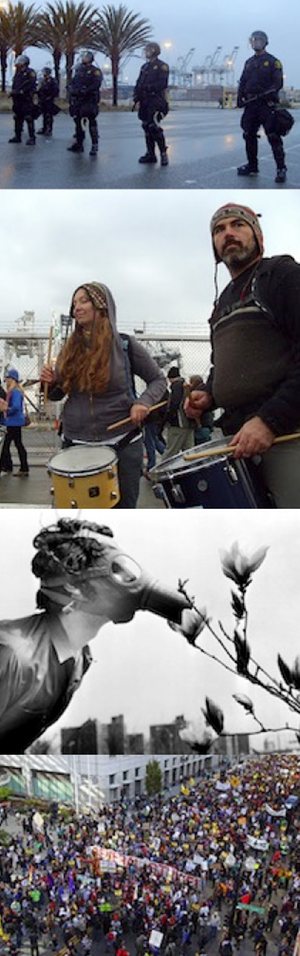
After the break: Steffen’s insightful breakdown of the heartfelt worldviews pulling against each other in this time, Starhawk on questions of strategy and the need for linear thinking guidance in horizontal consensus process, Solnit on the depth of the movement’s heart, and Meade’s evocation of the soul of the movement, of America, and of each of our lives. (Thanks to Riyana’s always-compelling Wild Serenity blog for the three color images in the strip above, and to Alex Steffen’s post for the black and white one.)
Bill Holm’s Chain Letter of the Soul
Horses
Go stand by the fence.
Keep quiet. The horses will come –
thirty, forty of them,
however many live and dine there.
They will put their long, narrow noses
one or two at a time
over the fence to nuzzle you,
maybe nibble on your shirt
or suck your finger.
They are watching you
with full attention.
You look curious to them:
docile and harmless.
They want to touch you, pet you,
see what skin feels like.
Don’t disappoint them.
From Chain Letter of the Soul, a volume of his New and Selected Works published near the time of his death in 2009. I just ordered it – never heard of him until moments ago when I read four of his poems in Wildness and Captivity, an online journal edited by Mary Davis (of the Wildlands Project and Wild Earth fame, at least for me; oops: that Mary Davis died in early 2011) on a website new to me, Mythic Imagination. Here’s one more from Bill:
New Religion
This morning no sound but the loud
breathing of the sea. Suppose that under
all that salt water lived the god
that humans have spent ten thousand years
trawling the heavens for.
We caught the wrong metaphor.
Real space is wet and underneath,
the church of shark and whale and cod.
The noise of those vast lungs
exhaling: the plain chanting of monkfish choirs.
Heaven’s not up but down, and hell
is to evaporate in air. Salvation,
to drown and breathe
forever with the sea.
Never, never to forget
To love.
To be loved.
To never forget your own insignificance,
To never get used to the unspeakable violence
and the vulgar disparity of life around you.
To seek joy in the saddest places.
To pursue beauty in its lair.
To never simplify what is complicated
or complicate what is simple.
To respect strength, never power.
Above all, to watch.
To try and understand.
To never look away.
And never, never to forget.
Arundhati Roy, from The End of Imagination
Comet Lovejoy blazes through sun’s corona
Something amazing happened tonight: a tiny comet skimmed just above the surface of the sun. Yeah, this happens pretty regularly, as we noted awhile back, but this one was special: an amateur astronomer Terry Lovejoy of Australia spotted the inbound comet about 2 weeks ago, giving astronomers worldwide plenty of time to train their sites on it as it blew ’round the sun. No one knew if it would survive its closest approach, which occurred at about sunset here in New Mexico.
SOHO, the space-based solar observatory, caught this sequence of its approach (the video covers almost 4 days):
While the brightness might make you think this is a giant comet, what you’re seeing is a cometary glow that blows out the sensitive CCD sensors, which are meant to help resolve the subtle, faint structures in the sun’s corona (which you can see dancing around in the images). The actual sun diameter is the inner circle; the outer circle blocks the brightest corona so the cameras can watch the outer corona. This comet was about 200m in diameter; while it’s the largest of over 2000 sun-grazing comets seen since SOHO launched in 1996, this is still puny by cometary standards – the small but very close Hyakutake was about 2km (2000m) in diameter, Halley’s is about 15km, and Hale-Bopp about 40km. Still, late this afternoon, the comet was brighter than the brightest stars or planets, though too close to the sun to be seen with the naked eye.
And tonight, this amazing video came in from the Solar Dynamics Observatory, showing the comet apparently surviving perihelion, whizzing through the solar corona. It passed only 140,000km above the sun’s surface: that’s just ten or so earth-diameter! Yoswa. (the video loops three times, each time in slower motion)
I tell ya, we’ve got some pretty darn amazing eyes on the skies these days! (Here’s another view of the closest passage, offering a wider perspective, and here’s the SOHO view from the next morning, showing the tail left behind as the comet emerges and heads back out away from its hairy close encounter with our star.)
For more images and a complete run-down on the approach and passage of Comet Lovejoy, check out AstroBob’s day-of coverage and his posts in the few days before and after.
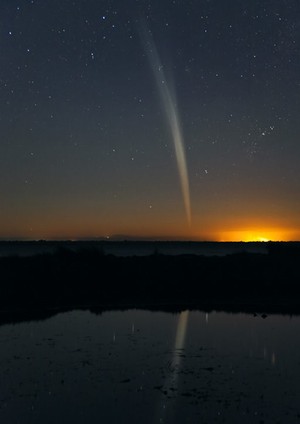
UPDATE, 12/22/11: Not only did our little hero survive, but it’s putting on a nice, though subtle, morning show in the southern hemisphere. The tail is 15 degrees long, about half of which is visible to the naked eye just before sunrise; as always, cameras bring out the detail with slightly longer exposure times. Here’s one from Colin Legg of Mandurah, Western Australia, recently posted on SpaceWeather.com:
 Bright Blue Ball (spinning spinning free)