Category Archives: Nourishing Words
Writings of others I want you to know about
Welcome to the Golden Tablet Age of long-form journalism
Just when it seemed that journalism had been reduced to pithy two-paragraph blog posts and three-minute TV news or website video snippets, with 15-minute “in depth” reports on 60 Minutes being the height of investigative insight, a shining light has appeared through the clouds!
Fueled largely by the emergence of the Kindle as a place to read during down-time without staring into a glowing screen, and further encouraged by the more recreational media browsing that’s become popular on the iPad, “long-form journalism” is making a dramatic comeback in this age of bite-sized news. Thanks to several excellent editorial aggregators, lovers of the well-crafted essay, compelling profile, and in-depth on-the-ground reporting from around the globe now have easy access to the best work of the world’s best journalistic writers. Drawing from current print and online publications, as well as the archives of such stalwarts of the form as The Atlantic, The New Yorker, The London Review, Vanity Fair, Foreign Affairs, and many more, these sites offer a treasure-trove of writing that’s well worth settling down with for a half hour or hour.
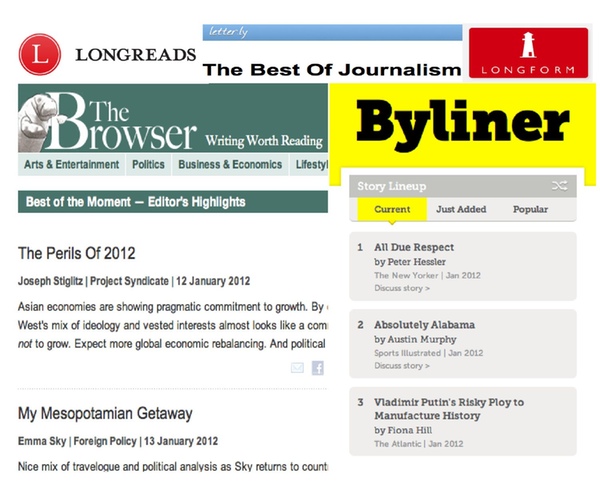
From these sites (links below), you can check out the opening sections of their latest recommended items and load the full pieces in your browser, then send them to your Kindle (with readily-available plug-ins), add them to your Read It Later or Instapaper reading list, perhaps to be accessed from your iPad or laptop some evening or weekend, or, of course, read right on your computer.
Just as a taste, today’s top selections include a Foreign Policy piece by a recent visitor to Iraq, a new Atlantic piece on Vladimir Putin’s risky game of bending history in Russia, a Grantland look on concussions in high school football, a piece from Businessweek on the inventor of a revolutionary new sneaker that never made it to market, and an Adbusters look at “peak nature.” Oh, and an old 1952 tour of trailer parks and a new Sports Illustrated profile of Michael Jordan’s high school coach. Longform’s Best of 2011 included an incredible 3-part cautionary tale about Derek Boogaard, an NHL “enforcer,” a heart-wrenching story about Vaughn, Georgia, one of the towns wiped from the map by last year’s tornado swarms, one on a blind man who learned to navigate his world by echolocation, and a visit to a crazy Russian movie set, home to thousands. While no one will be interested in all of this, a weekly perusal of these sites is sure to reward every reader with a few gems.
I encourage you to check a few of these editorial sites out, and see which ones strike your fancy over time. I get something from them all. Byliner is the most reliably
Ten times a day
Ten times a day something happens to me like this – some strengthening throb of amazement – some good sweet empathetic ping and swell.
This is the first, the wildest and the wisest thing I know: that the soul exists and is built entirely out of attentiveness.
Mary Oliver
(can’t find the source, though it appears to be prose, in that every time it appears online it has no line breaks.)
Bill Holm’s Chain Letter of the Soul
Horses
Go stand by the fence.
Keep quiet. The horses will come –
thirty, forty of them,
however many live and dine there.
They will put their long, narrow noses
one or two at a time
over the fence to nuzzle you,
maybe nibble on your shirt
or suck your finger.
They are watching you
with full attention.
You look curious to them:
docile and harmless.
They want to touch you, pet you,
see what skin feels like.
Don’t disappoint them.
From Chain Letter of the Soul, a volume of his New and Selected Works published near the time of his death in 2009. I just ordered it – never heard of him until moments ago when I read four of his poems in Wildness and Captivity, an online journal edited by Mary Davis (of the Wildlands Project and Wild Earth fame, at least for me; oops: that Mary Davis died in early 2011) on a website new to me, Mythic Imagination. Here’s one more from Bill:
New Religion
This morning no sound but the loud
breathing of the sea. Suppose that under
all that salt water lived the god
that humans have spent ten thousand years
trawling the heavens for.
We caught the wrong metaphor.
Real space is wet and underneath,
the church of shark and whale and cod.
The noise of those vast lungs
exhaling: the plain chanting of monkfish choirs.
Heaven’s not up but down, and hell
is to evaporate in air. Salvation,
to drown and breathe
forever with the sea.
Never, never to forget
To love.
To be loved.
To never forget your own insignificance,
To never get used to the unspeakable violence
and the vulgar disparity of life around you.
To seek joy in the saddest places.
To pursue beauty in its lair.
To never simplify what is complicated
or complicate what is simple.
To respect strength, never power.
Above all, to watch.
To try and understand.
To never look away.
And never, never to forget.
Arundhati Roy, from The End of Imagination
Facing the Future
Well, it’s been a couple months of dabbling in this new creative/vision/writing outlet, and I find that I’m having a hard time getting started with one of the key themes I want to be addressing here: facing the future that we’ve made for ourselves. We’ve seen it coming for decades, but haven’t managed to turn the wheel. Yet still, and always, there are glimmers of hope, light shining through the cracks, viable paths to a future that is more caring, balanced, and connected to the greater pulses of love and truth and beauty from which all this emerged. This is a era at’s been described as The Great (economic) Unravelling, The Great (environmental) Disruption, and The Great (social) Turning; all of these hinge on the question of whether we’ll allow the present course to continue relatively unchecked, or find our way toward a new set of priorities in greater balance with natural systems and with a deeper sense of shared responsibility for the wellbeing of all.
But can be hard, so hard, to find our way through the sorrow, the fear, the anger and despair about where we’ve gotten ourselves to. It’s just as hard to even acknowledge the sorrow and its brethren that lurk there, in each and every breath we take as we walk through our days in this troubled world. Yet once we do, once we allow the emotional and soul-level responses that follow from all the horrors that we see and know and imagine, we then have a ground from which we can move in a way that’s more able to engage both the wounded world and the widespread efforts to lift each other up in the midst of this time of such great uncertainty.
This aspect of Bright Blue Ball won’t be detailing the troubles; there’s plenty of places for that. Instead, I’ll share here some of the voices that speak from the heart in ways that acknowledge our dire situation while holding a larger perspective in which there’s room to move and act and care and engage. For starters, I want to share fairly recent messages from two of the great elders of our time, Wendell Berry and Joanna Macy.
Here’s a snippet of Joanna, about embracing the uncertainty of our time:
We’ll hear more from Joanna here, in the weeks to come. If you can’t wait, check out this video of a passionate presentation at Bioneers in 2009, which will be featured here before long.
And now to Wendell, voice of the rural soul. This is one of his “sabbath poems,” written in 2007, and published in his most recent collection, Leavings.
VI
It is hard to have hope. It is harder as you grow old,
for hope must not depend on feeling good
and there is the dream of loneliness at absolute midnight.
You also have withdrawn belief in the present reality
of the future, which surely will surprise us,
and hope is harder when it cannot come by prediction
any more than by wishing. But stop dithering.
The young ask the old to hope. What will you tell them?
Tell them at least what you say to yourself.
 Bright Blue Ball (spinning spinning free)