Author Archives: Jim
Facing the Future
Well, it’s been a couple months of dabbling in this new creative/vision/writing outlet, and I find that I’m having a hard time getting started with one of the key themes I want to be addressing here: facing the future that we’ve made for ourselves. We’ve seen it coming for decades, but haven’t managed to turn the wheel. Yet still, and always, there are glimmers of hope, light shining through the cracks, viable paths to a future that is more caring, balanced, and connected to the greater pulses of love and truth and beauty from which all this emerged. This is a era at’s been described as The Great (economic) Unravelling, The Great (environmental) Disruption, and The Great (social) Turning; all of these hinge on the question of whether we’ll allow the present course to continue relatively unchecked, or find our way toward a new set of priorities in greater balance with natural systems and with a deeper sense of shared responsibility for the wellbeing of all.
But can be hard, so hard, to find our way through the sorrow, the fear, the anger and despair about where we’ve gotten ourselves to. It’s just as hard to even acknowledge the sorrow and its brethren that lurk there, in each and every breath we take as we walk through our days in this troubled world. Yet once we do, once we allow the emotional and soul-level responses that follow from all the horrors that we see and know and imagine, we then have a ground from which we can move in a way that’s more able to engage both the wounded world and the widespread efforts to lift each other up in the midst of this time of such great uncertainty.
This aspect of Bright Blue Ball won’t be detailing the troubles; there’s plenty of places for that. Instead, I’ll share here some of the voices that speak from the heart in ways that acknowledge our dire situation while holding a larger perspective in which there’s room to move and act and care and engage. For starters, I want to share fairly recent messages from two of the great elders of our time, Wendell Berry and Joanna Macy.
Here’s a snippet of Joanna, about embracing the uncertainty of our time:
We’ll hear more from Joanna here, in the weeks to come. If you can’t wait, check out this video of a passionate presentation at Bioneers in 2009, which will be featured here before long.
And now to Wendell, voice of the rural soul. This is one of his “sabbath poems,” written in 2007, and published in his most recent collection, Leavings.
VI
It is hard to have hope. It is harder as you grow old,
for hope must not depend on feeling good
and there is the dream of loneliness at absolute midnight.
You also have withdrawn belief in the present reality
of the future, which surely will surprise us,
and hope is harder when it cannot come by prediction
any more than by wishing. But stop dithering.
The young ask the old to hope. What will you tell them?
Tell them at least what you say to yourself.
Attenborough’s Wonderful World
On the occasion of his final BBC series, here’s to Sir David:
My favorite comment on the YouTube page: “David Attenborough should narrate my life.”
Thanks to Andrew Sullivan’s indispensably rich and diverse blog (politics, science, religion, society, wonder), The Dish, for the heads-up!
The curious case of the unmentioned rainbow snow sparkles
This morning I rose during first light and was in my chair with a cup of Earl Grey when sunlight brushed the eastern edge of the hill across the canyon above Thor’s. Once the sun cleared the ridge and so began streaming across the front yard – which is practically an extension of my living room, thanks to six large windows – I picked up the binoculars to take an Enhanced Vision look at the sparkling snow.

And spent the next fifteen minutes lost-found-exploring-endazzled in a bejeweled beauty. Sprinkled along my line of sight, in an area about ten feet around between the bird feeders and piñon trees (with a second patch further out the same line past the trees), were hundreds of tiny gemstones, vividly alight in all the colors of the rainbow, along with a few fancy colors for good measure (deep teal, bright carnelian). One little foot-wide hummock of sun-splashed snow sported dozens of just-visible specks of color, a dense scattering of tiny pixie-dust flackes; while beyond across a wider expanse of several feet, larger electric-bright confetti chips glared in brilliant red, vivid blue, warm orange, and piercing green, while just occasionally, a gramma-grass head shone with a spot of attention-grabbing violet, seemingly the rarest of the ice-prism’s children in this dance of color. (The most evocative of very few pictures online, shown here courtesy of AstroBob’s astronomy blog, is less than half the density and intensity of color that I was seeing, and seems to lack the larger pieces.)
I’m puzzled as to why this dazzlingly magical yet really rather common wintry delight isn’t more widely celebrated, commented on, or just plain noticed. Maybe there’s an unspoken pact in the Natural Wonder Society to not speak of this and other similarly subtle-yet-revelatory cracks between the worlds; are some small openings such as this more powerful when they come as a total surprise?
I surely remember the soul-shaking delight I felt on that December morning at El Morro when Jack and I crawled from our tent into a frost-enrobed landscape sparkling briliiant white in the low sun, and walked slowly around the edge of the campground, laughing inside at the raw amazingness of the way the grasses, rocks, and trees all pulsed in a dance of light, individual flakes of ice and snow blinking on and off as we wandered this crystalline world.
Bright Eyes: leaping onto my Top 10 Concerts list with a bullet!
This fall, I was psyched to go with Rosa to see Conor Oberst with his long-time main band, Bright Eyes. I got turned on to him thanks to an NPR online concert, and he became a common musical ground for Rosa and I, a good and rare thing for an 18 and 54 year old pair of music lovers.
But little did I know how amazing it would be! By the time it was over, this show had popped into the Top 10 Concerts of All (my) Time list, not something that happens very often any more (three of my Top 10 have come in the new millennium).
Conor’s an intense and inspired songwriter, exploring with a voracious honesty the dark corners of experience (his, those he encounters, all of ours), as well as casting light on our hopes (ragged as they may be these days), always coming from a place of raw and exposed heart and soul, reaching deep. A totally charismatic stage presence, as well, by far the most compelling front man I’ve ever seen up close in a small club. Add Mike Mogis, who’s been his guitar-slinging sidekick for over a decade, and a way-tight-yet-explosive band of two keyboards, two drummers, bass, and occasional trumpet, and you’ve got a recipe for a good time! I don’t know nearly his whole catalog, but got easily caught up even in totally unknown songs whose words I could only catch snatches of: a riveting couplet would reach out and grab me while my body was carried along by the churning band and then sent soaring by a burst of grand rock’n’roll cacophony.
Though scouring YouTube to try to recreate something remotely representative of being there in the midst of it all is a fool’s errand (count me as foolish for the past couple of hours or so), I managed to come up with a solid hour-long video playlist that gives a decent sense of why I feel really lucky to have caught this band in what’s said to be their final tour. There’s a good chance Conor and Mike will continue to do things together; Mogis was the non-singing “fourth man” and producer for the supergroup Monsters of Folk, which brought together three of the top 30-something songwriters into the CSN of their generation; check Conor, Jim James, and M Ward out on this Austin City Limits show. (oops; expires on Christmas! Bah humbug. Here’s a 3-song NPR session.)
Okay, on with the show!
We’ll dive right in at maximum impact, with the final song of most of the shows on this tour, and the final song on Bright Eyes’ final album, The People’s Key. One for You, One for Me:
And a taste of his gentler songwriting, in Bowl of Oranges:
For a bunch more, click on through!
Snowy passage
On a recent evening, as the canyon was settling into the stillness of our first real snow of the year, I stepped outside to take in the last shades-of-grey light of the day. The snow was falling at just the right pace to let the far hills almost a mile up-canyon be just barely visible through the diffuse white filter of the falling flakes. From this barely-there backdrop, each closer ridge and hill was a bit more solidly “here” – the ridge across from us half-obscured, the one next door above Jim’s a quarter less present than normal. And in the near foreground, the steady fall of visible flakes, turning the yard’s air into a filled three-dimensional matrix of activity, rather than “empty space” between me and the piñons, or me and the bird-feeder tree.
Snow somehow connects sky and earth in a way rain doesn’t quite evoke. Perhaps it’s the slower falling: we can clearly perceive each flake passing by on its journey from cloud to ground. Perhaps also snow invites us into its presence more readily; even without hat or coat, I lingered long and easily. Rain fills the space and leaves no room for us without succumbing to its moisture, while snow occupies the space while allowing us to enter without hunkering down. (Well, at least a still snowfall…biting winds create quite a different moment!)
So, there I am, drinking in the canyon’s body around me, appreciating the dimensionality provided by the flake-filled air. A neighbor’s voice from across the way – surprisingly clear. Then an odd creaking noise, just a couple of pulses of it, from up the canyon. A strange sound: not quite mechanical, yet neither vocal (coyote? cat? human? No…) The raspy sounds come again, a few more, maybe four or five pulses jumbled together, a totally out of place artifact. What where who why?
And suddenly, I realize: cranes! Will I see them through the snow? The calls come closer, and yes!, a broad curved V – call it a very wide U – glides down the canyon. Just a few voices (maybe a half dozen or so) from thirty-ish birds, wings pumping. Now, just briefly as they pass by, the soft whir of three score feathered arms…and almost as soon as I can revel in this magnificently gentle touch being passed through the space between them and I, the subtle sound is lost, this expansive visitation sliding along silently once more, down over Thor’s and into the snowy distance.

Recording: Erick Burres Photo: Ask the Birds
Late! Caught in the storm en route to the Bosque del Apache? Most of the thousands of winter residents arrive there in November; this is either some cold-hearty crew that enjoys dancing the edge of winter on their way south, or a bunch of stragglers who reveled a bit too long in the late fall of their summer home, or perhaps relaxed into a spell of Indian Summer along the way….
They must have been winging their way down the eastern slope of the Rockies, swinging down over Las Vegas (NM) and Glorieta Pass, now picking up the Galisteo valley as they head for the Rio Grande. For the time-stopping forty seconds that they passed through my snow revelry, they soared directly over the river, winging intently along the watercourse, which travels southwest here; interesting that they weren’t taking a southernly beeline to the Bosque, which would have taken them far south of this point.
No doubt my human speculations about where from and why now and which way are as far off base as they can possibly be; what do I know of the ways of cranes? And so I ask forgiveness for my indulgence, and return to that fleeting, extended moment when a fleet of wings passed through this wintry calm, and I say: carry on, wild ones!
Spirit in a time of remembering
I’ll admit to having a hard time winnowing my lists of online reading; I want to, I really do, but new wellsprings of worthy writing keep appearing. One of the latest is a spin-off of Killing The Buddha, a long-established fount of reflections on spirituality in our culture. On the new site, freq.uenci.es, which I glance at once a week (it’s part of my “Tuesday” tab set), this hit me like a ton of bricks:
The present epoch is historically unique in that the spirit-side of life can no longer be taken for granted. It appears both in innumerable fragmentary shapes and as massive blocs of fundamentalist and totalizing conviction, and quite often it seems to not exist at all, as though there were some kind of systematic power at work to drive it out of our lives.
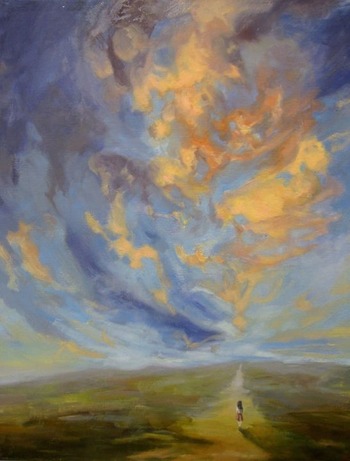
Indeed! Call it consumerism, media overload, mechanistic thinking, or simply lives too full of things to do and places to go; the end result for too many of us is a fragmentary relationship to spirit, and for more still, a disengagement from what has been, for most of human history, the central unifying thread of individual and community lives. But what do we mean here by “spirit?” Joel Kovel begins this essay, entitled spirituality, revolutionary by laying it out out about as concisely as I’ve ever seen:
In all places and all epochs human beings have used some such word as “Spirit,” to designate the animating, world-moving force within them; the relations with ancestors, demons, totems, ghosts and other “spirit-beings”; and the Supreme Being, the godhead that permeates the universe and creates the world and is bound together in our religions. In sum, what has been known as spirit relates the human self to the universe and all its beings and forms of being. Spirit is no residual category, then, but an ontological potential of humanity, a vital part of being human. It is as essential for human nature as building a web is for “spider nature.” For all creatures are inserted into nature at a certain point and with a certain internally articulated set of relationships. These frame the possible arrangements that creature has with the rest of nature.
No doubt one reason Kovel’s piece hit fertile ground in me this week is that I’m currently re-reading David Abram’s most recent book, Becoming Animal, which can be seen as taking that final thought above and running with it: into the wilderness, around the world, and deep inside our own engagement with the landscape around us. Abram reminds us of one way back to spirit: by coming alive in our bodies within the larger body of the earth. And more than that: he questions our cultural conviction that our experience of the world is somehow an interior thing, each of us with our own skull-encapsulated mind, which may be just an ephemeral consequence of purely mechanical neural activity. What a lonely and hollow way to experience this essence of what it is to be human! Reflecting on the obvious communicative interactions among all the living things of the world, Abram suggests:
Mind is not at all a human possession, but is rather a property of the earthly biosphere—a property in which we, along with the other animals and the plants, all participate. The apparent interiority that we ascribe to the mind (may) have less to do with the notion that there is a separate mind located inside me, and another, distinct mind that resides inside you, and more to do with a sense that you and I are both situated inside it—a recognition that we are bodily immersed in an awareness that is not ours, but is rather the Earth’s.
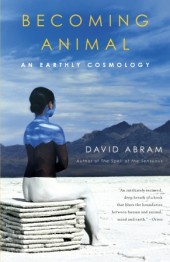
Never fear: Abram’s “mind” is far more than our thinking selves. His renewed animism aims deeper, reminding us of traditions, science findings, and direct experiences that suggest a deep coherence, a world in which the western split between spirit and matter is rejected, bridging the great divide created by Descartes’ declaration that the human mind (and spirit, the “I am”) stands apart from the entire material world. Instead, we are invited into a remembrance that our local habitat is a “diversely differentiated field of animate beings, each of which has gifts relative to the others. And we find ourselves not above, but in the very midst of this living field, our own sentience part and parcel of the sensuous landscape.” All the miraculous wonder of our earthly creation (and in a subtler way, also the sun and cosmos beyond) sharing a fundamental commonality of reciprocity and mutual engagement in which “our own sentient organism is…an intensification or fluctuation within the sensitive flesh of the world.” This is an embodied spirituality both ancient and utterly revolutionary in our modern world.
More after the break: (image above right: Lydia Larson)
Tom Russell: mining a mighty rich vein
In my music review days, I’d sampled one of Tom Russell’s albums, a twisted and heartfelt immersion in the beat era called Hotwalker. It was like nothing I’d ever heard (featuring “vocals” from Bukowski, Kerouac, Bruce, Abbey, and even pulling in Dave Van Ronk to play guitar, wrapped in folk/story tales); it ended up filed on my CD closet shelf that’s labeled “Oddball/Strange Tales.” So when I saw a few months back that he was coming to town, I snapped up a ticket with very little sense of what to expect; not surprisingly, Hotwalker was way out on the edge of Tom’s catalog, but my compass was tuned in for sure. A true songwriting genius, Tom sings the lives of all sorts of folks, in riveting and heart-wrenching directness. A night with Tom Russell is an American history lesson of the highest order.
‘Nuff said by me. Catch him if you can! And here’s a few introductory earfulls:
From his newest album, the title track, honoring a young Hibbing boy and their shared lodestars:
This video from a rooftop in Dublin features Thad Beckman, the same guitarist he had with him in Santa Fe, an excellent duo, doing a fantastic song about Tom’s ’60’s stint in Africa, called East of Woodstock, West of Vietnam:
For a bunch more of Tom’s many facets, click on through
RIP, Lynn Margulis
 Lynn Margulis died this week shortly after suffering a stroke. She was a biologist whose work became one of the foundations of my understanding of life and of the mysteries of creation and evolution; she’s right there with Gary Snyder and Thomas Berry in my pantheon of inspirations and guiding lights (see my memorial post for Thomas here). Lynn’s fundamental insight was that evolution is driven at least as much by symbiosis as by competition and natural selection; she was convinced that the forward motion, the new forms, the creative impulse, underlying life was at its heart a process of two or more different organisms coming together and becoming something different than either could be on their own. At the largest scale, she saw all life on earth as the result of collaborations between bacteria: her biggest contribution to science was the realization that plant cells and animals cells began as symbiotic collaborations of bacteria. Rather than seeing animals, or humans, as the pinnacle of evolution, her picture celebrated the entire biosphere as a reflection of the unimaginable complexity of bacterial communities. Her lasting legacy is a view of life on earth that is centered on collaboration more than competition – a blending toward a greater purpose rather than a struggle for individual domination.
Flying Ant Day 2011
Yesterday morning the front yard bloomed with tiny tinkerbells, shimmering in the sun. First a few, then dozens, probably hundreds at a time, angling up and across the yard, swept along by a light breeze. What could it be? I first grabbed the binoculars by my side, to see if super-vision would help identify them, but they moved too fast. Walking outside and letting them fly toward and over me didn’t improve matters: they were so small, all I could be sure of was that they had four long slender Tinkerbell-ish wings, two on each side. But who were these wings carrying?
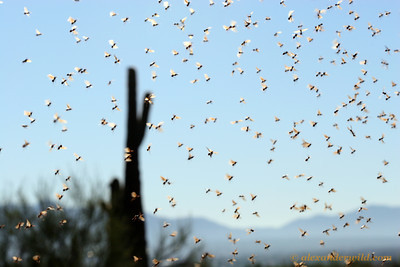
These are larger, leafcutter ants, photographed in Arizona by Alex Wild; click to visit a page on his site with lots of great photos of Flying Ant Day in Tucson
I tried reaching out, hoping to sweep one into my hand on its way by, but each one that came close flitted away, and their bodies were just too small to get a glimpse of. Finally one bumped and landed on my shirt, and I was able to gently pick it up by the wings, bring it up close to my increasingly enfeebled eyes, and finally see that the heads were decidedly ant-like. Yes, indeed, no doubt: they were ants!
At the same time, standing out there, I began to realize that they weren’t coming into the yard on the breeze, but were rising up from the among the tufts of gramma grass stalks now heavy with seed. Looking closer at the ground, I confirmed that indeed our local community of tiny “sugar ants” were on the move, at least some of them. The ground was littered with them, milling about, making sense of these new diaphanous appendages and preparing to launch up and out into a sudden freedom from the solid, welcoming ground that was all their kin had known til now.
 Bright Blue Ball (spinning spinning free)