Category Archives: Earth
Touching and being touched by the landscapes and hidden nooks
50 years of seeing the big picture
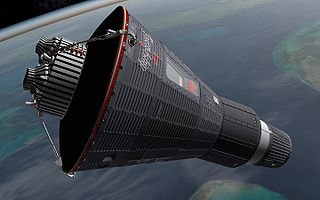
Fifty years ago this week, John Glenn became the first American to orbit the earth. While we remember this largely as a technological achievement, one of many steps toward flying humans to the moon and robot probes to the planets and beyond, it was also a profound aesthetic, experiential threshold for all of us down below. By the end of the decade, NASA celebrated our forever-changed awareness with the publication of the first book of space photos, This Island Earth (amazingly, still available for spare change from used booksellers!). Glenn and those who followed him into orbit, and on to the moon, remain a vanguard among humanity; they saw with their own eyes, felt with their bodies, breathed with their souls, something the rest of us can only feel in our imaginations. Their words and pictures have charted a vision of our place in space that we’re still only beginning to live in to.
Alexis Madrigal of The Atlantic put together a short and evocative post that draws on today’s vast library of space images to illustrate some of Glenn’s radioed descriptions of things no American – and only two other humans, Russian cosmonauts Yuri Gagarin and Gherman Titov – had ever seen:
“In the periscope, I can see the brilliant blue horizon coming up behind me; approaching sunrise. Over.” Mission Control replied, “You are very lucky.” Glenn said, “You’re right. Man, this is beautiful.”

Head on over to read Alexis’s post in full; it’s well worth the couple of minutes it’ll take!!
The living sky
The Earth lives within the larger body of the solar system; every planet a uniquely marvelous manifestation of minerals and gasses, with perhaps some liquid and frozen components or molten rock and volcanism cracking through the surface, each world alive and dynamic in its own ways. One of Earth’s many wonders is its incredibly dynamic atmosphere; winds carrying seeds and weather and scents, clouds shifting shape from moment to moment and changing color as they slip through the edges of the day and night, stars sprinkled and spinning across the night sky. At the highest latitudes, where the nights are long and cold, and the highest altitudes, the atmosphere thinning to nearly nothing, the earth’s physicality is expressed in subtle electromagnetic fields, which come alive in dancing waves of light, enlivened ions given color and motion when our local star exhales great gusts of itself in waves of charged particles that sweep past our tiny home of earth, water, fire, and air.
In the past couple of years, several filmmakers have been producing stunning time-lapse films of the natural world, utilizing high-definition cameras, sensitive digital CCDs, and sometimes even slow cinematography-style tracking shots. Today, I came across (thanks, Dish) the most compelling northern lights film I’ve yet to see; the sheer beauty of the motion and color, as well as a welcome variety of tones and intensities, kept me riveted through the entire five minutes (which, sadly, is quite an accomplishment for online video!).
The one time I was lucky enough to experience a full ribbons-of-light-overhead aurora display, in my backyard in Old Town, Maine in the winter of 1980-81, I likened it to a visual version of the rippling sounds of the Mahavishnu Orchestra….this film captures that blend of fluidity and surprise, intense dynamics, and sheer wonder like no other I’ve seen:
Letting Go, Sinking In
“I just couldn’t take it anymore in Santa Barbara—or Hell, I call it,” he was saying. “When you’re thinking about getting out of Hell, you tend to think about. . . let’s see. . . Heaven! And I was lucky enough to have Heaven well-marked in my brain.”
“And a direct path between Hell and Heaven,” I noted, “that’s quite a trick!” So he’s back; twice before he’s lived within five miles of this place for a year or more, and it’s time again.
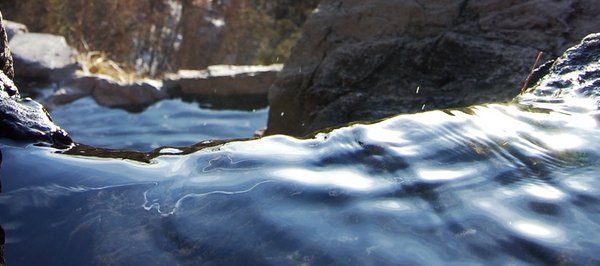
Images: Karie Reinertson, Shelter Protects You
As for me, it’s a touchstone in the pulse of seasons. Two or three times a year I return to these earth-warmed waters for some of the deepest recharges I’ve found in this life; it’s gotten amazingly consistent, to the point that now I pretty much count on the nourishment that I’ll find here. Hmm, that sounds like the first inkling of trouble—I guess it all depends on how I meet what comes: this time, next time, every time.
Here in the wintry depths of the year, the sun is low all day through the forest as I head down from the car. It’s been fairly warm, so the stream is virtually ice-free (just a few dangling fingers along the bottoms of some boulders, suspended above the water line). Today I move right across the canyon bottom, and head on up the far slope. Pause at the first crossing of the little stream flowing down from the springs, where the fireflies danced one late spring night (the seasons are always out of synch in this little three-by-six-foot zone, never fully winter, summery expressions by April). Fingers slip into the flowing warmth; green grass (!), snow-laden pine bough, browned-but-supple tendrils of last year’s growth. A moist grey boulder presides over little pool, edged by a patch of bright watercress. Up the slope a ways, ice under last night’s light snowfall makes me focus intently on each step, the forest around receding as my attention turns to the ground below and just in front of me. Gotta remember to remember this on the way down!
Quite a crowd at the pools, for a weekday afternoon: a chatty Asian party (I feel a bit ignorant not knowing if that’s Japanese, Chinese, or Korean being spoken….), a couple urban anglos, a young hippie (short hair, but his open face shines softly, a subtler freak flag flying), and a quiet Hispano-Indian guy sitting up by the cave. The hippie, who turns out later to be the one who’s returned to his Heaven, calls up, “welcome to the springs. . .”
“Thanks, it’s great to be back,” is the reply, true and simple.
But as usual, before sinking in, I head up the slope above the waters. This magical forest is at least as much a draw as the hot springs.
Attenborough’s Wonderful World
On the occasion of his final BBC series, here’s to Sir David:
My favorite comment on the YouTube page: “David Attenborough should narrate my life.”
Thanks to Andrew Sullivan’s indispensably rich and diverse blog (politics, science, religion, society, wonder), The Dish, for the heads-up!
The curious case of the unmentioned rainbow snow sparkles
This morning I rose during first light and was in my chair with a cup of Earl Grey when sunlight brushed the eastern edge of the hill across the canyon above Thor’s. Once the sun cleared the ridge and so began streaming across the front yard – which is practically an extension of my living room, thanks to six large windows – I picked up the binoculars to take an Enhanced Vision look at the sparkling snow.

And spent the next fifteen minutes lost-found-exploring-endazzled in a bejeweled beauty. Sprinkled along my line of sight, in an area about ten feet around between the bird feeders and piñon trees (with a second patch further out the same line past the trees), were hundreds of tiny gemstones, vividly alight in all the colors of the rainbow, along with a few fancy colors for good measure (deep teal, bright carnelian). One little foot-wide hummock of sun-splashed snow sported dozens of just-visible specks of color, a dense scattering of tiny pixie-dust flackes; while beyond across a wider expanse of several feet, larger electric-bright confetti chips glared in brilliant red, vivid blue, warm orange, and piercing green, while just occasionally, a gramma-grass head shone with a spot of attention-grabbing violet, seemingly the rarest of the ice-prism’s children in this dance of color. (The most evocative of very few pictures online, shown here courtesy of AstroBob’s astronomy blog, is less than half the density and intensity of color that I was seeing, and seems to lack the larger pieces.)
I’m puzzled as to why this dazzlingly magical yet really rather common wintry delight isn’t more widely celebrated, commented on, or just plain noticed. Maybe there’s an unspoken pact in the Natural Wonder Society to not speak of this and other similarly subtle-yet-revelatory cracks between the worlds; are some small openings such as this more powerful when they come as a total surprise?
I surely remember the soul-shaking delight I felt on that December morning at El Morro when Jack and I crawled from our tent into a frost-enrobed landscape sparkling briliiant white in the low sun, and walked slowly around the edge of the campground, laughing inside at the raw amazingness of the way the grasses, rocks, and trees all pulsed in a dance of light, individual flakes of ice and snow blinking on and off as we wandered this crystalline world.
Snowy passage
On a recent evening, as the canyon was settling into the stillness of our first real snow of the year, I stepped outside to take in the last shades-of-grey light of the day. The snow was falling at just the right pace to let the far hills almost a mile up-canyon be just barely visible through the diffuse white filter of the falling flakes. From this barely-there backdrop, each closer ridge and hill was a bit more solidly “here” – the ridge across from us half-obscured, the one next door above Jim’s a quarter less present than normal. And in the near foreground, the steady fall of visible flakes, turning the yard’s air into a filled three-dimensional matrix of activity, rather than “empty space” between me and the piñons, or me and the bird-feeder tree.
Snow somehow connects sky and earth in a way rain doesn’t quite evoke. Perhaps it’s the slower falling: we can clearly perceive each flake passing by on its journey from cloud to ground. Perhaps also snow invites us into its presence more readily; even without hat or coat, I lingered long and easily. Rain fills the space and leaves no room for us without succumbing to its moisture, while snow occupies the space while allowing us to enter without hunkering down. (Well, at least a still snowfall…biting winds create quite a different moment!)
So, there I am, drinking in the canyon’s body around me, appreciating the dimensionality provided by the flake-filled air. A neighbor’s voice from across the way – surprisingly clear. Then an odd creaking noise, just a couple of pulses of it, from up the canyon. A strange sound: not quite mechanical, yet neither vocal (coyote? cat? human? No…) The raspy sounds come again, a few more, maybe four or five pulses jumbled together, a totally out of place artifact. What where who why?
And suddenly, I realize: cranes! Will I see them through the snow? The calls come closer, and yes!, a broad curved V – call it a very wide U – glides down the canyon. Just a few voices (maybe a half dozen or so) from thirty-ish birds, wings pumping. Now, just briefly as they pass by, the soft whir of three score feathered arms…and almost as soon as I can revel in this magnificently gentle touch being passed through the space between them and I, the subtle sound is lost, this expansive visitation sliding along silently once more, down over Thor’s and into the snowy distance.

Recording: Erick Burres Photo: Ask the Birds
Late! Caught in the storm en route to the Bosque del Apache? Most of the thousands of winter residents arrive there in November; this is either some cold-hearty crew that enjoys dancing the edge of winter on their way south, or a bunch of stragglers who reveled a bit too long in the late fall of their summer home, or perhaps relaxed into a spell of Indian Summer along the way….
They must have been winging their way down the eastern slope of the Rockies, swinging down over Las Vegas (NM) and Glorieta Pass, now picking up the Galisteo valley as they head for the Rio Grande. For the time-stopping forty seconds that they passed through my snow revelry, they soared directly over the river, winging intently along the watercourse, which travels southwest here; interesting that they weren’t taking a southernly beeline to the Bosque, which would have taken them far south of this point.
No doubt my human speculations about where from and why now and which way are as far off base as they can possibly be; what do I know of the ways of cranes? And so I ask forgiveness for my indulgence, and return to that fleeting, extended moment when a fleet of wings passed through this wintry calm, and I say: carry on, wild ones!
RIP, Lynn Margulis
 Lynn Margulis died this week shortly after suffering a stroke. She was a biologist whose work became one of the foundations of my understanding of life and of the mysteries of creation and evolution; she’s right there with Gary Snyder and Thomas Berry in my pantheon of inspirations and guiding lights (see my memorial post for Thomas here). Lynn’s fundamental insight was that evolution is driven at least as much by symbiosis as by competition and natural selection; she was convinced that the forward motion, the new forms, the creative impulse, underlying life was at its heart a process of two or more different organisms coming together and becoming something different than either could be on their own. At the largest scale, she saw all life on earth as the result of collaborations between bacteria: her biggest contribution to science was the realization that plant cells and animals cells began as symbiotic collaborations of bacteria. Rather than seeing animals, or humans, as the pinnacle of evolution, her picture celebrated the entire biosphere as a reflection of the unimaginable complexity of bacterial communities. Her lasting legacy is a view of life on earth that is centered on collaboration more than competition – a blending toward a greater purpose rather than a struggle for individual domination.
Flying Ant Day 2011
Yesterday morning the front yard bloomed with tiny tinkerbells, shimmering in the sun. First a few, then dozens, probably hundreds at a time, angling up and across the yard, swept along by a light breeze. What could it be? I first grabbed the binoculars by my side, to see if super-vision would help identify them, but they moved too fast. Walking outside and letting them fly toward and over me didn’t improve matters: they were so small, all I could be sure of was that they had four long slender Tinkerbell-ish wings, two on each side. But who were these wings carrying?
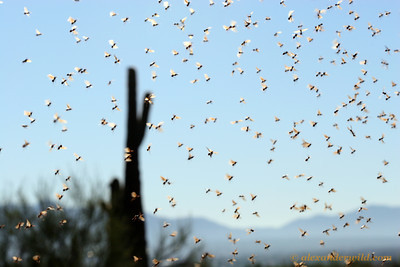
These are larger, leafcutter ants, photographed in Arizona by Alex Wild; click to visit a page on his site with lots of great photos of Flying Ant Day in Tucson
I tried reaching out, hoping to sweep one into my hand on its way by, but each one that came close flitted away, and their bodies were just too small to get a glimpse of. Finally one bumped and landed on my shirt, and I was able to gently pick it up by the wings, bring it up close to my increasingly enfeebled eyes, and finally see that the heads were decidedly ant-like. Yes, indeed, no doubt: they were ants!
At the same time, standing out there, I began to realize that they weren’t coming into the yard on the breeze, but were rising up from the among the tufts of gramma grass stalks now heavy with seed. Looking closer at the ground, I confirmed that indeed our local community of tiny “sugar ants” were on the move, at least some of them. The ground was littered with them, milling about, making sense of these new diaphanous appendages and preparing to launch up and out into a sudden freedom from the solid, welcoming ground that was all their kin had known til now.
A new trail with nice views
That’s what Barb said she had found, and on Saturday morning we headed out, her at the wheel, to check it out. But rather than head out of town, we found our way to the Santa Fe Airport, where Matt was waiting….to take us flying over our beloved landscape!!
 A total surprise, and a major treat. Our 90 minutes aloft took us around the Jemez, our local supervolcano remnant, over Abiquiu, down the Rios Chama and Grande, and across the mountains above Santa Fe to check out this summer’s “smaller” local conflagration, dubbed the Pacheco Fire. Here’s a few of the many shots Barb took while we were being continually bedazzled:

Valle San Antonio, the northern portion of the great volcanic caldera of the Jemez
(click through for a bunch more shots)
 Bright Blue Ball (spinning spinning free)